
PI介绍
翟宗昭博士,教授,博导,曾获得国家引进海外高层次人才青年项目和欧盟玛丽居里学者项目。2004年本科毕业于河北大学;2012于中国科学院动物研究所获博士学位(动物学),师从杨星科研究员,期间入选首届中国科学院与德国马普学会联合培养博士生项目,于德国马普学会发育生物学研究所(2006-2008)和德国海德堡大学(2009-2012)Ingrid Lohmann教授实验室从事研究工作,研究方向为转录调控与果蝇肿瘤模型;2012-2017在瑞士洛桑联邦理工大学(EPFL)Bruno Lemaitre教授实验室进行博士后研究,研究方向为肠道上皮稳态调控与天然免疫。2018加入湖南师范大学生命科学学院,开展机体生理与免疫的调控机制研究。邮箱/Email:zongzhao.zhai(AT)foxmail.com
Education & Positions of the PI (Zongzhao Zhai)
2018-now Professor
College of Life Sciences, Hunan Normal University
**Recipient of the national "Thousand Young Talents Program" of China (2018-2021)
2012-2017 Postdoctoral researcher
École polytechnique fédérale de Lausanne (EPFL), Switzerland
Advisor: Prof Bruno Lemaitre
**Marie Curie Fellow (funded project name "gutENCODE", 2013-2015)
2004-2012 Institute of Zoology, Chinese Academy of Sciences. PhD.
Advisors: Prof. Xingke Yang & Prof Ingrid Lohmann
Research fully carried out in the lab of Prof Ingrid Lohmann in Germany.
- Max Planck Institute for Developmental Biology, Tuebingen (2006.11-2008.12)
- University of Heidelberg (2009.01-2012.03)
2000-2004 College of Life Sciences, Hebei University. BSc.
课题组研究兴趣
1. 天然免疫
我们生活在微生物环境中。微生物感染可诱发多种疾病,但天然免疫系统能够通过相应的模式识别受体(PRRs)识别微生物或损伤相关的分子模式(MAMPs/DAMPs)为机体构筑起第一道防线,并启动和指导脊椎动物的获得性免疫应答。无脊椎动物和植物则完全依赖天然免疫来抵御病原入侵。此外,天然免疫还参与维持机体稳态、塑造微生物群落,并在癌症、神经退行性疾病、代谢综合征及衰老等疾病过程中发挥重要作用。
果蝇因其在遗传、分子及生理操作上的便捷性,已成为当前研究最为透彻的天然免疫模式生物之一。其天然免疫机制与哺乳动物高度保守,因此具有重要的生物医学意义。例如,2011年诺贝尔奖获奖成果发现果蝇Toll蛋白介导抗真菌免疫 (Lemaitre B, …, Hoffman JA 1996 Cell),这一发现为后续鉴定Toll样受体在哺乳动物天然免疫识别中的作用奠定了基础,也从根本上改变了我们对天然免疫基本原理的认识。同时,果蝇免疫研究还为昆虫防治和利用提供重要参考,并为揭示宿主与微生物互作中的新概念和根本原理赋能。本实验室以果蝇为主要研究模型,致力于揭示调控机体天然免疫的新机制。当前主要研究内容包括:
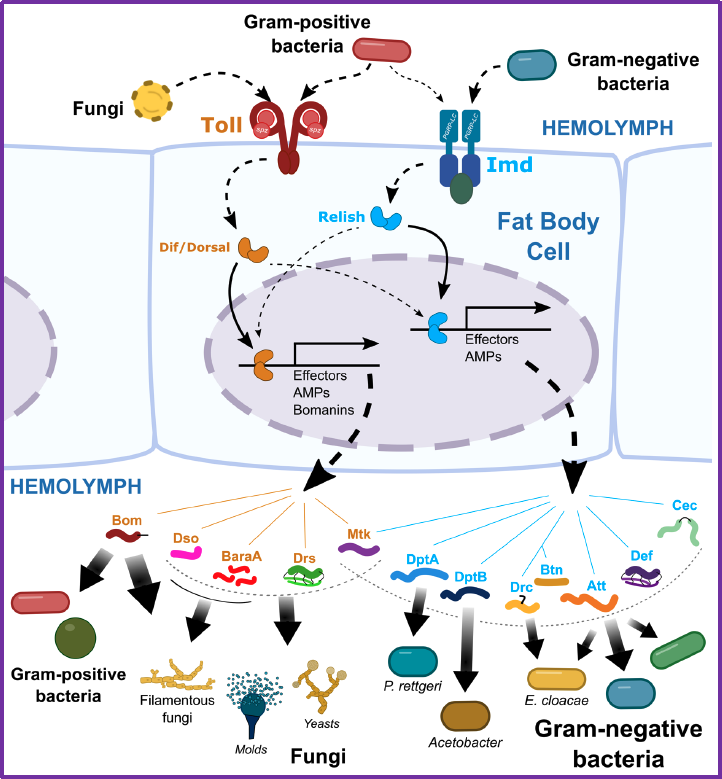
Westlake H., Hanson, M.A., Lemaitre, B. (2024), The Drosophila Immunity Handbook. EPFL Press)
(1)控制免疫效应因子产生的翻译调控机制。抗菌肽(AMPs)是宿主防御的关键效应分子。免疫激活后,全局蛋白质翻译受到抑制,但免疫效应因子的翻译却被选择性增强,从而大量产生AMP蛋白。在转录水平上,昆虫AMPs受到IMD和Toll通路下游的NFⲕB转录因子调控;但在翻译水平上,感染所诱导的翻译重编程机制——即在全局翻译受抑的情况下如何优先翻译AMPs——目前尚不清楚。我们将通过构建检测工具,结合翻译组学技术和果蝇遗传学优势,力求填补这一空白。
(2)宿主防御的多层次调控与免疫生理学。免疫与生理紧密交织。免疫系统并非孤立发挥作用,宿主防御反应受到多个层次的复杂调控,同时对机体代谢、生长和行为产生重要影响。例如,我们此前的研究表明,果蝇IMD免疫信号通路介导了感染引起的肠上皮细胞脱落 (Zhai Z, …, Lemaitre B 2018 Immunity),提示存在一种进化上保守的上皮组织稳态调控机制。我们关注免疫如何塑造宿主生理状态,以及生理状态如何反向影响免疫应答,力求在更完整的机体生理背景下理解免疫应答的执行和作用。当前具体研究内容包括:神经与代谢对免疫的调控、肠道免疫与生理功能的协调、交配状态等内在状态对机体免疫的影响,以及感染对睡眠等行为的影响。
2. 动物营养生理
动物营养生理研究机体如何感知、利用营养物质来支持生长、发育和行为。一个核心问题是:氨基酸等营养素如何被检测、吸收,并最终调控机体生理。氨基酸不只是蛋白质合成的原料,也是重要的信号分子,能激活雷帕霉素靶蛋白复合物1(mTORC1)等关键代谢通路。mTORC1的激活促进蛋白质翻译、核糖体发生和脂质合成等合成代谢过程,同时抑制自噬等分解代谢途径。其活性异常与癌症、代谢综合征、神经退行性疾病和衰老密切相关。通过磷酸化真核起始因子4E结合蛋白(4E-BP)和p70 S6激酶(S6K),mTORC1在促进蛋白质合成中起核心作用,而蛋白质合成是机体最耗能的过程之一,与健康和寿命紧密相关。mTORC1虽然翻译水平上调控所有mRNA,但对编码翻译机器蛋白(包括几乎所有核糖体蛋白)的mRNA作用最快、最明显。这些约100种mRNA被称为TOP mRNA,它们的5′端紧接帽结构处有一段寡聚嘧啶序列(TOP),合计可占细胞总转录本的15–20%,是细胞翻译的重要组成部分。我们尤其关心氨基酸如何被感知并影响机体生理状态。近期我们研究发现,在果蝇脂肪组织中必需氨基酸诱导一种生理性mTORC1效应因子,该因子反馈增强mTORC1活性,并促进依赖于4E-BP的TOP mRNA的翻译水平(Wang et al., 2026 Nature)。这项工作提示机体存在一种可诱导的机制,能在整体水平放大mTORC1输出,形成一个由机体生理和资源状况控制的能量利用调节器。
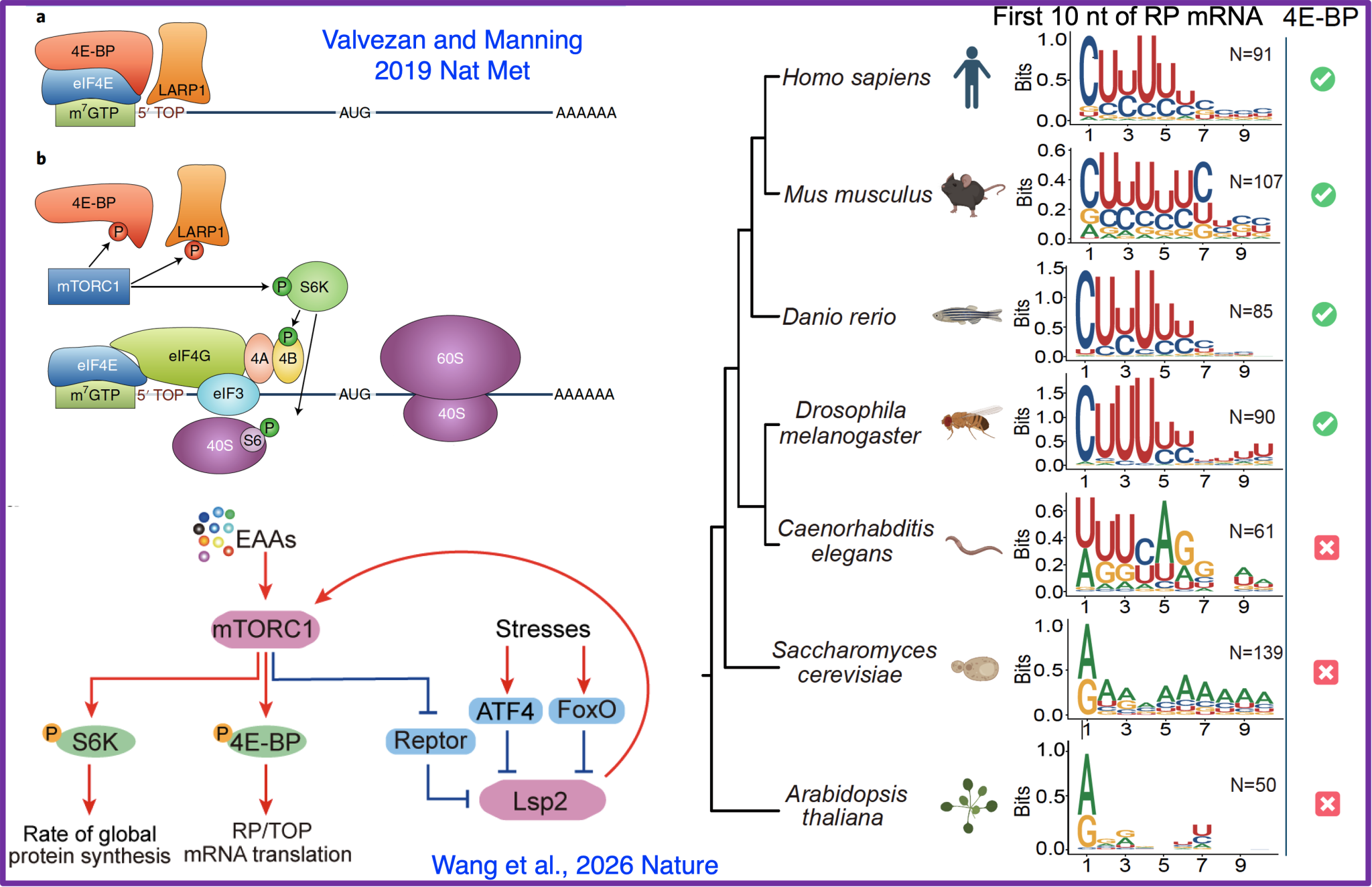
本实验室使用果蝇和蚊虫研究氨基酸营养生理,一方面希望揭示动物营养感知和生理代谢调控的基本规律,另一方面为蚊虫控制提供思路。目前的研究包括以下三个方向:
(1)机体水平上的氨基酸感知与mTORC1激活。机体从多个层次感知氨基酸,味觉受体、肠上皮细胞以及mTOR和GCN2通路的感受器等都参与其中。我们关注果蝇脂肪组织(昆虫免疫和代谢调控中心)如何感知循环中的氨基酸水平。已有数据提示,必需氨基酸(EAA)的不同属性(总量、种类完整性等)分别由不同通路检测,共同调控果蝇Lsp2的表达水平上(一种脂肪体特异的翻译调控因子)。其中,mTORC1信号感知亮氨酸、甲硫氨酸等特定EAA,FoxO感知整体EAA水平,ATF4则可能检测EAA失衡。培养的哺乳动物细胞中氨基酸感知相对简单,只有亮氨酸、精氨酸、甲硫氨酸等少数EAA目前有明确的感受器并接入mTORC1通路上游信号。但在整体动物水平,氨基酸感知和mTORC1调控要复杂得多。目前,我们继续通过检测Lsp2水平和经典mTORC1活性指标,评估不同氨基酸对体内mTORC1激活的贡献。另外,我们也采用遗传学手段寻找mTORC1通路的调控因子。已经进行了以转运蛋白基因为主要候选基因的果蝇遗传筛选,对这些候选基因的功能分析,将帮助我们理解mTORC1通路在机体水平的组织形式和调控机制。
(2)TOP mRNA翻译调控。TOP序列特征在哺乳动物核糖体蛋白(RP)mRNA中普遍存在,在果蝇RP mRNA中也很完整,但酵母、线虫和植物的RP mRNA却没有该特征。有意思的是,这些物种同时也缺乏明确的4E-BP同源蛋白。这说明果蝇同时进化出TOP序列和4E-BP,从而获得新的翻译调控机制把营养感知和生长控制联系起来。我们尤其关注机体选择性调控TOP mRNA翻译的分子机制。已有结果显示4E-BP在其中起关键作用,但LARP1等其它RNA结合蛋白可能协助4E-BP识别TOP mRNA。未来在果蝇中通过详细研究Larp和4E-BP有望揭示TOP序列介导的翻译控制在动物中的工作方式和演化起源。
(3)蚊虫吸血行为的调控机制。蛋白质营养对昆虫生殖至关重要。雌虫在卵黄发生和卵母细胞成熟阶段需要大量氨基酸来合成卵黄蛋白。雌蚊吸血本质上是为了获取蛋白质以满足生殖需求。此外,血餐后的几天内蚊虫的宿主搜寻行为会被抑制。我们推测,吸血行为的启动和终止由体内氨基酸水平和营养信号通路共同控制;揭示调控蚊虫蛋白质食欲的生理机制,将为减少蚊虫叮咬提供新思路。
Research Interests
1. Innate immunity
We live in a microbial world. Although acute or chronic microbial infections can lead to many life-threatening diseases, our immune system plays a vital role in defending against invaders including bacteria, viruses, fungi and transformed cells. Recognizing microbe- or damage-associated molecular patterns (MAMPs or DAMPs) via specialized pattern recognition receptors (PRRs), innate immunity provides the first line of defense in vertebrates, precedes and instructs adaptive immunity. In invertebrates and plants, innate immunity is the sole host defense mechanism. Beyond infection control, innate immunity contributes to homeostasis, shapes the microbiota, and influences disease contexts such as cancer, neurodegeneration, metabolic syndromes, and aging, collectively referred to as immune‑pathology or immune‑physiology.
Owing to its amenability to genetic, molecular, biochemical, and physiological manipulations, Drosophila has become one of the best‑characterized metazoan model systems for studying immunity. Fly immune research has broad biomedical relevance, as innate immune mechanisms are conserved in mammals. Notably, the 2011 Nobel Prize-winning discovery that the Drosophila protein Toll mediates immune responses to fungal infection (Lemaitre B, …, Hoffman JA 1996 Cell) was pioneering: it paved the way for the identification of Toll‑like receptors as essential regulators of mammalian host defense and fundamentally shaped our understanding of the fundamental principles in innate immunity. Furthermore, fly immunity research has major agricultural implications, offering insights into how insects in general cope with their microbial environment. Finally, and importantly, Drosophila provides a powerful platform for exploring new concepts in host–microbe interactions.
Our laboratory mainly uses the fruit fly Drosophila melanogaster as a model system to uncover novel principles governing the modulation of innate immune responses in an organism. Current projects include the following:
(1) Translational control of immune effectors. Production of antimicrobial peptides (AMPs) is a major host defense mechanism. Upon immune activation, general host translation is suppressed, yet the translation of immune effectors is selectively activated to produce large amounts of AMP proteins. At the transcriptional level, AMPs are regulated by the IMD and Toll pathways in Drosophila. However, at the translational level, the molecular mechanisms underlying infection-induced translational reprogramming—how AMP translation is selectively activated under conditions of global translational suppression—remain completely unexplored. By generating new tools to monitor immune effector levels and applying state-of-the-art translatomics techniques, combined with the power of fly genetics, we aim to fill this critical gap in innate immunity.
(2) Multi-layered modulation of host defense and immune-physiology. Immunity and host physiology are deeply interconnected. Far from functioning as an isolated defense system, the Drosophila immune system is intimately woven into the broader physiological landscape, operating through conserved signaling pathways that coordinate immune responses while simultaneously exerting profound control over host metabolism, growth, and behavior. For instance, our previous work showing that fly IMD immune signaling mediates infection-induced epithelial cell shedding (Zhai Z, …, Lemaitre B 2018 Immunity) pointed to the existence of a fundamental and shared principle altering epithelial homeostasis. We are interested in elucidating how immune responses shape (and are shaped by) host physiology, and we seek to understand immunity within a wider, integrated physiological context. Current projects in this direction include characterizing the neuronal and metabolic regulation of host immunity, the coordination of gut immunity and physiology, the influence of internal states of the organism such as mating status on immunity, and how infection affects host behaviors such as sleep.
2. Animal nutritional physiology
Animal nutritional physiology focuses on how organisms sense and utilize nutrients for growth, development, and behaviors. At its core lies the question of how macronutrients—especially amino acids—are detected, absorbed, and converted into physiological decisions. Amino acids serve not only as building blocks for protein synthesis but also as potent signaling molecules that activate central metabolic regulators such as mechanistic target of rapamycin complex 1 (mTORC1). Once activated, mTORC1 coordinates anabolic processes including protein translation, ribosome biogenesis, and lipid synthesis, while suppressing catabolic pathways such as autophagy; its aberrant activation is closely associated with cancer, metabolic syndrome, neurodegenerative diseases, and aging. By phosphorylating the eukaryotic initiation factor 4E-binding protein (4E-BP) and p70 S6 kinase (S6K), mTORC1 is central to promoting protein synthesis, arguably the most energy-intensive process that is tightly linked to organismal health and lifespan. While mTORC1 translationally regulates all mRNAs, it exerts its most rapid and pronounced effect on mRNAs encoding proteins of the translation machinery including nearly all the ribosomal proteins (RPs). These ~100 mRNAs referred to as TOP mRNAs share a 5′-terminal oligopyrimidine motif (TOP) directly adjacent to the 5′ cap and collectively can comprise 15–20% of total cell transcripts, forming a significant part of cellular translation. We are particularly interested in amino acid sensing and the subsequent organismal physiology, and have recently discovered that dietary essential amino acids induce in Drosophila adipose tissue a physiological mTORC1 effector that feeds back to increase mTORC1 activity and to promote 4E-BP–dependent TOP mRNA translation (Wang et al., 2026 Nature). This study raises a concept that an inducible mechanism operates at the organismal level to amplify mTORC1 outputs, serving as a resource-gated switch of energy utilization.
Using Drosophila and mosquitoes, our lab studies amino acid nutritional physiology, aiming at both revealing fundamental principles of animal nutrient sensing and metabolic regulation and providing new insights for mosquito vector control. Current projects include the following:
(1) Amino acid sensing and mTORC1 activation at the organismal level. Amino acid availability is sensed at multiple levels, including by taste receptors, intestinal epithelial cells, and systemic sensors of the mTOR and GCN2 pathways. Focusing on systemic amino acid sensing by the Drosophila adipose tissue, our work suggests that distinct aspects of essential amino acid (EAA) availability (quantity, compositional completeness, etc.) are detected by parallel pathways that converge on fly Lsp2 regulation (a fat body-specific translational regulator), including mTORC1 signaling (sensing specific EAAs such as leucine and methionine), FoxO (sensing global EAA levels), and ATF4 (likely sensing EAA imbalance). Amino acid sensing in cultured mammalian cells seems comparatively simple, because only a handful of EAAs, including leucine, arginine, and methionine, are recognized by well-defined sensors upstream of mTORC1. By contrast, at the organismal level, amino acid sensing and mTORC1 regulation are likely to involve far more elaborate mechanisms. Using Lsp2 levels and canonical mTORC1 activity indicators as readouts, we will continue to assess the amino acid requirements for full mTORC1 activation at the organismal level. Complementing this approach, we have completed a Drosophila genetic screen centered on transporter genes to identify regulators of the mTORC1 pathway. Functional characterization of the resulting hits should offer new mechanistic insights into how this pathway is organized and regulated.
(2) TOP mRNA Translation. The TOP feature, found in human RP mRNAs, is fully present in Drosophila RPs but absent from yeast, worms, and plants. Interestingly, these organisms also lack a clear 4E-BP orthologue, suggesting that TOP motifs and 4E-BP co-evolved in Drosophila as part of a recently acquired mechanism linking nutrient sensing to translational control of growth. A key question is how TOP mRNAs are selectively regulated: while 4E-BPs are critical for this process, other RNA-binding proteins, such as LARP1, are thought to assist in selecting TOP mRNAs. Future studies of Larp and 4E-BP in the fly, combined with ongoing efforts to elucidate TOP mRNA regulatory mechanisms, promise to reveal both the organismal logic and evolutionary history of TOP motif-mediated translational control.
(3) Mechanisms regulating mosquito blood feeding. Protein nutrition is essential for insect reproduction. During vitellogenesis and oocyte maturation, female insects require large amounts of amino acids to synthesize yolk proteins. The blood-feeding behavior of female mosquitoes is therefore best understood as a protein-acquisition strategy driven by reproductive demands. We hypothesize that its initiation and termination are governed by internal amino acid levels and nutrient signaling pathways. Notably, host-seeking behavior is suppressed for several days following a blood meal. Thus, elucidating the physiological mechanisms that regulate mosquito protein appetite may inform new strategies to inhibit mosquito biting.
主持科研项目 / Funding (as PI)
· 湖南优势特色学科群(发育生物学与生物育种)-重点项目(延续资助)2026XKQ2303,2026
· 湖南省自然科学基金-重点项目2025JJ30009,2025
· 国家自然科学基金-面上项目32170509,2022
· 湖南优势特色学科群(发育生物学与生物育种)-重点项目2022XKQ0203,2022
· 澳优乳业(中国)有限公司-横向项目,2020
· 国家自然科学基金-面上项目31871469,2019
· 湖湘高层次人才聚集工程-青年创新人才2018RS3067,2018
· 国家引进海外高层次人才项目-青年项目(第14批),2018
· 湖南省自然科学基金-杰出青年基金2018JJ1015,2018
· 湖南师范大学“潇湘学者”特聘教授启动经费,2018
· 欧盟-玛丽居里基金 (Marie-Curie IEF fellowship)-gutENCODE 330852,2013
代表性成果 / Representative publications
(*corresponding author; #equal contribution)
Wang, J.#, Cai, Z.#, Gu, J., Xiong, S., Yi, J., Yang, M., Chang, K., Ning, X., Wen, Y., Yan, Y., Lu, J.*, Wang, Y.*, Zhai, Z.* (2026). Lsp2 links mTORC1 to TOP mRNA translation and lifespan in Drosophila. Nature. https://doi.org/10.1038/s41586-026-11029-x.
Su, J., Yang, M., Wang, X., Wu, P.* & Zhai, Z.* (2026). Intracellular Abeta42 Sequestration by a Serine Protease Mitigates Neurotoxicity in a Drosophila Alzheimer's Disease Model. Adv Sci (Weinh) 13, e17862, doi:10.1002/advs.202517862.
Wang, Y.#, Huang, R.#, Deng, M.#, He, J., Deng, M., Ishibashi, T., Yu, C., Zhai, Z.*, and Yan, Y.* (2025). Oncogenic Ras, Yki and Notch signals converge to confer clone competitiveness through Upd2. J Genet Genomics. 10.1016/j.jgg.2025.04.017.
Gao, J., Zhang, S., Deng, P., Wu, Z., Lemaitre, B., Zhai, Z.*, Guo, Z.* (2024). Dietary L-Glu sensing by enteroendocrine cells adjusts food intake via modulating gut PYY/NPF secretion. Nature Communications 15, 3514. 10.1038/s41467-024-47465-4.
Wang, J., Gu, J., Yi, J., Li, J., Li, W., and Zhai, Z.* (2024). High-fat diets induce inflammatory IMD/NFkappaB signaling via gut microbiota remodeling in Drosophila. Front Cell Infect Microbiol 14, 1347716. 10.3389/fcimb.2024.1347716.
Liu, X., Yang, S., Yao, Y., Wu, S., Wu, P.*, Zhai, Z.* (2022). Opsin1 regulates light-evoked avoidance behavior in Aedes albopictus. BMC Biology 2022 May 13;20(1):110. doi: 10.1186/s12915-022-01308-0.
Zhai Z*, Boquete J-P, Lemaitre B* (2018). Cell-Specific Imd-NF-κB Responses Enable Simultaneous Antibacterial Immunity and Intestinal Epithelial Cell Shedding upon Bacterial Infection. Immunity 48(5):798-910. doi: 10.1016/j.immuni.2018.04.010 [Preview by Chen, G. Y. and Ayres, J. S. (2018). "When the Gut Gets Tough, the Enterocytes Get Going." Immunity 48(5): 837-839.]
Zhai Z*, Huang X, Yin Y (2018). Beyond immunity: The Imd pathway as a coordinator of host defense, organismal physiology and behavior. Dev Comp Immunol 83:51-59. doi: 10.1016/j.dci.2017.11.008
Zhai Z*, Boquete J-P, Lemaitre B* (2017). A genetic framework controlling the differentiation of intestinal stem cells during regeneration in Drosophila. PLoS Genetics 13(6): e1006854
Zhai Z*, Kondo S, Ha N, Boquete J-P, Brunner M, Ueda R, Lemaitre B* (2015). Accumulation of differentiating intestinal stem cell progenies drives tumorigenesis. Nature Communications 6:10219 doi: 10.1038/ncomms10219.
Zhai Z, Ha N#, Papagiannouli F#, Hamacher-Brady A#, Brady N#, Sorge S, Bezdan D, Lohmann I* (2012). Antagonistic regulation of apoptosis and differentiation by the Cut transcription factor represents a tumor suppressing mechanism in Drosophila. PLoS Genetics 8(3): e1002582. [Featured in Nature Reviews Cancer, 2012, 12(5): 320; Recommended by F1000]
Our team
2025年底(长沙-IFS)

2025年(湘江欢乐城-欢乐雪域)

2023年(张家界国家森林公园)

2021年(长沙后湖)

2019年 (湖南师大生科院)